Maccabeats Suffer "Wardrobe Malfunction"
http://momentmagazine.wordpress.com/2010/12/07/maccabeats-suffer-%E2%80%9Cwardrobe-malfunction%E2%80%9D/
Wednesday, December 8, 2010


Tuesday, December 7, 2010
The Lesson of Rabbi Uriel Malka

For a large number of people, our very existence in this world is a test. What exactly this test entails has always been a point of serious contention. While I would never assume to hold the answers to the universe (especially considering my struggles with Algebra 2) I do believe that one of the world’s greatest tests is our spiritual and conceptual response to tragedy. As Israel begins to emerge from its greatest natural disaster, the devastating fire in the North, a few public figures have already failed this test in my humble opinion.
I believe that as Jews we must strive to see G-d in all things, good and bad. However, we mustn’t blame him or interpret his intentions, no matter how tragic or unjust things may seem. It is no surprise that many “respected media figures” in the Arab world have attributed the catastrophic blaze to “G-d punishing Israel for occupying Arab land”. Likewise, it is hardly newsworthy that now that the fire has begun to subside the political finger pointing has commenced. However, it is incomprehensible that Shas spiritual leader Rav Ovadia Yosef proclaim with conviction that the fire in the North was a clear result of “the desecration of Shabbat”. While I respect Rav Ovadia for the Torah giant that he is, and while I am sure he means no malice in his statement, it must be emphasized that assigning tragedy to specific human actions is a treacherous practice.
It is irresponsible and misguided to assume we as human beings can assume to know G-d’s true intentions. The Talmud in Avot (4:10) supports this concept stating, “Do not act as judge alone, for none judges alone except One”. While this decree falls upon each and every one of us, the onus of this diktat sits far more heavily on the shoulders of our public figures and spiritual leaders.
I vividly recall a story I heard after the explosion of the Columbia Space Shuttle that killed the first Israeli astronaut Ilan Ramon, and the unsettling feeling the story left me with. A rabbi at the elementary school I had attended told his students that it was clear to him why the shuttle had exploded, killing the seven astronauts inside. He told his students that it was clearly because Ilan Ramon had brought a Torah scroll with him on the mission and since he was not religious the explosion was his punishment for desecrating the Torah scroll. The certainty with which the rabbi said this disturbed me equally as much as the content of his drivel. An elementary school rabbi has the daunting task of molding a child’s early interaction with religion and G-d and to irresponsibly pass off crack-pot theory to impressionable children is beyond the pale.
I honestly believe that the correct response to times of tragedy is an admission that we understand nothing. What we must understand however, is that G-d’s hand guides these event and that he is just in doing so. It is his world to build or destroy, we are merely renting space. That is not to say that we should not cry out to him for mercy. On the contrary, it is G-d, and only G-d, who can truly console us in these harrowing times.
The tragic irony is that the world was introduced to a hero of these very principles after he was killed by the raging fire. Rabbi Uriel Malka, a 32 year old prison chaplain and former teacher at the Denver Academy of Torah, was killed among 39 others on a prison transport bus that was surprised by the spreading flames, sadly robbing the world of what surely would have been a profound and thoughtful response to this time of tribulation. Rabbi Malka came face to face with death a number of times while serving in the IDF during the Second Lebanon War. Many from his unit were killed. Although he faced many terrors, he was described as a “simple and warm person, full of happiness for life, and a spreader of optimism to everyone”. His own brother recounted Uriel’s telling of his near-death experiences. “During his life he met death a number of times. G-d was always in front of him and saved him at the last moment.” While he was surrounded by devastation he chose to see the good in G-d’s actions. Rabbi Malka was an educator, who put nothing before the importance of the future of the Jewish people. In direct contrast to the Rabbi who denounced Ilan Ramon, Rabbi Malka chose to spread the eternal message of finding G-d’s light in the surrounding darkness. This is the way tragedy should be met with by members of the Chosen People.
Chief Rabbi of England Rabbi Lord Jonathan Sacks once wrote, “The beauty of Judaism is that it did not become traumatized by tragedy… It is that central affirmation of G-d as life, and therefore of finding G-d in the midst of the blessings of life, that we must not lose”. Rabbi Uriel Malka personified this message to the letter and although he was introduced to us through his heartbreaking and untimely death we should all strive to learn the immortal lesson of his life.
Thursday, December 2, 2010
Moment Magazine Blog Post!
The Heart of the Jewish People
http://momentmagazine.wordpress.com/2010/12/01/the-heart-of-the-jewish-people/
http://momentmagazine.wordpress.com/2010/12/01/the-heart-of-the-jewish-people/
Wednesday, November 17, 2010
Moment Magazine Blog Post!
Israel Mulls Settler Freeze
http://momentmagazine.wordpress.com/2010/11/17/israel-mulls-settler-freeze/
http://momentmagazine.wordpress.com/2010/11/17/israel-mulls-settler-freeze/
Friday, November 12, 2010
New Moment Magazine Blog Post!
The Limits of Political Protest
http://momentmagazine.wordpress.com/2010/11/11/the-limits-of-political-protest/
http://momentmagazine.wordpress.com/2010/11/11/the-limits-of-political-protest/
Monday, November 8, 2010
Empty Chair Syndrome
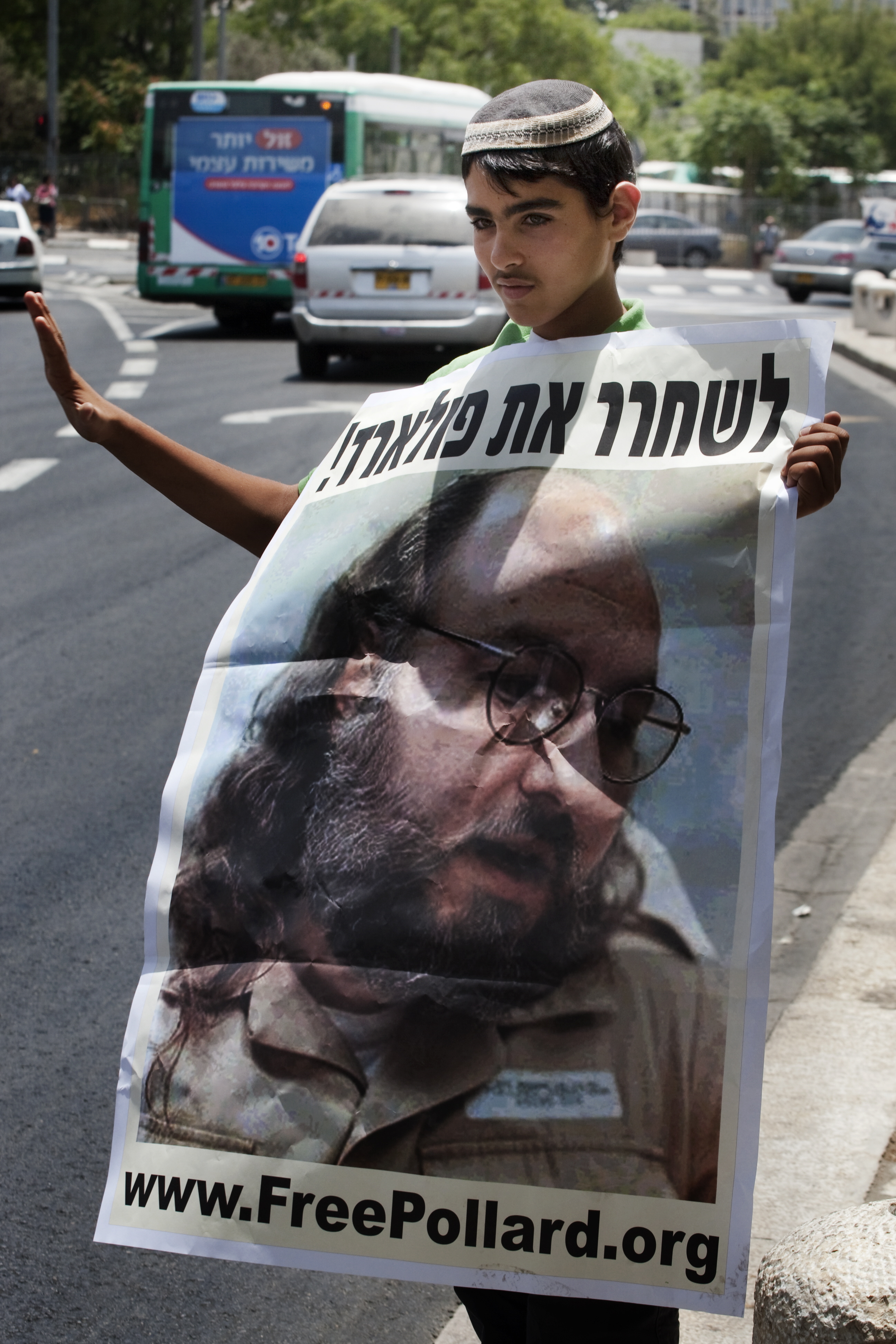
 In America his face is hidden deep in the bowels of a high security prison. In Israel his face greets you as you enter Jerusalem. Jonathan Pollard remains not only locked away from his friends and family in a U.S. prison, but from the Jewish American subconscious as well.
In Israel “he is still alive” is a motto of optimism and urgency. In America it is an actual and sadly necessary reminder of his tragic situation. Gilad Shalit is the face that stares at Israelis from every bus, billboard, and newspaper but is as ubiquitous as a pager in America.
Pollard is sitting in an American prison, serving out a, some say incongruous, sentence of life in prison for being convicted of espionage on behalf of Israel (recently the deputy of the American Defense Secretary that helped incriminate Pollard has acknowledged that Pollard has been given a disproportionate punishment).
Shalit has been held captive by Hamas since his abduction in 2006. Hamas has all but refused to release any information as to Shalit’s condition and has repeatedly balked at negotiations for his return.
While Pollard and Shalit are two very distinct issues, each with its own complexities and opinions, they are both inextricably linked as the faces of the current Israeli political and cultural narrative. Not so in America.
While the world is no stranger to Jewish American apathy, indifference to their suffering brothers is no longer the gravest cause for concern. Apathy has given way to ignorance. The utter lack of dialogue on issues such as Pollard and Shalit in America is the American Jewish Establishment’s most alarming miscue. Many American Jews may feel torn between their allegiance to Israel and America over Pollard, but to erase it from the narrative altogether is far from the answer. The always maddening debate over whom and what would be acceptable to trade to bring Shalit home can bring the closets of friends to blows, but never should it be swept under the rug. No sane person would argue that Israeli society has reached a consensus on either Pollard or Shalit, however it is in dealing with these sticky issues that Israeli society truly distinguishes itself as a pluralistic and democratic entity in a region where such values are sparse. Jewish Americans are being trained to involve themselves in every human rights cause there is…that is except for the trials of their own people. The dismissal of Jewish issues such as Pollard and Shalit can only breed disregard and ignorance, two things no community is in demand of.
The solution to this daunting predicament is for Jewish American groups to adopt the Israeli mindset in relation to Pollard and Shalit. Israeli culture suffers/benefits from “empty chair syndrome”, the incessant awareness that there is a person missing when sitting down to the proverbial family feast. This cognizance of vacancy then leads to a discussion in every mini-mart, taxi cab, and Shabbat table in the country. American Jewry is suffering from “crisis at the neighbor’s house” syndrome. Instead of making sure their own house is in order, they jump up from the table to fight their neighbors’ fights first. No attempts are made to solve the problem of the glaring empty chair. It must be asked: how can you run out to save your neighbor when an empty chair blocks your front door?
“Empty chair syndrome” is not a new concept in Judaism. During the Passover Seder we fill a cup for Elijah the Prophet, as well as open the door for him, in the hopes that he arrive and lead us to salvation. During the Succot holiday we invite different Biblical icons into our Succot. Their lack of physical attendance serves as our motivation to analyze our lives in the hopes of living more righteously the rest of the year. Israel has adapted this concept for Pollard and Shalit and American Jewry must do the same.
Hopefully, the Jewish American community can transform themselves into a community that confronts the issues of its own people first and foremost. While fighting against injustice in Darfur and women’s rights in Iran has true altruistic merit, Jews must first grapple with their own affairs if they hope to survive long enough to help the rest of the world. Hopefully, the American Jewish Establishment can right the ship so that they can move the empty chair away from the front door and be able to open it for Pollard, Shalit, and the rest of their stranded brethren when they come home to reclaim their seats at the table.
1st Moment Magazine Blog Article!!!
ObamaCare Turns the Tables on the Jewish Mothers
http://momentmagazine.wordpress.com/2010/10/28/obamacare-turns-the-tables-on-the-jewish-mothers/
http://momentmagazine.wordpress.com/2010/10/28/obamacare-turns-the-tables-on-the-jewish-mothers/
Subscribe to:
Posts (Atom)